About the Author

My photo
White male. 5'6. 125 lbs.

Monday, September 12, 2011


Thursday

On Thursday morning I got to Israel Plads just in time to hop on the bus.  For some reason I can't quite put my finger on, the bus looks like it arrived straight out of the 1970s.  There are 24 students in my program, and we are accompanied by two instructors: Thorsten, our Danish-German professor, and Keith, a British professor unaffiliated with our class.  Driving south from Copenhagen, we enter the Danish boondocks: expensive gas stations, convenience stores selling smørrebrød, and Jägermeister warehouses.  On the way to the docks on the south coast of Sealand, we watch a depressing movie called Flammen og Citronen (Flame and Citron), about two heroic but ill-fated members of the Danish resistance.  

Upon arriving at the dock, we drive onto the ferry.  The ride to Lübeck, in northwestern Germany, is about 45 minutes.  The wind is so strong on deck that I have to clutch my camera to take this photo:
 
As we near the German dock, we board the bus again and drive half an hour from the harbor to the town of Lübeck.  Thorsten comments that local Germans are upset about a plan to build a bridge from one of the nearby islands to the coast.
Homes on a river by the harbor.

Sheep grazing by the shore.

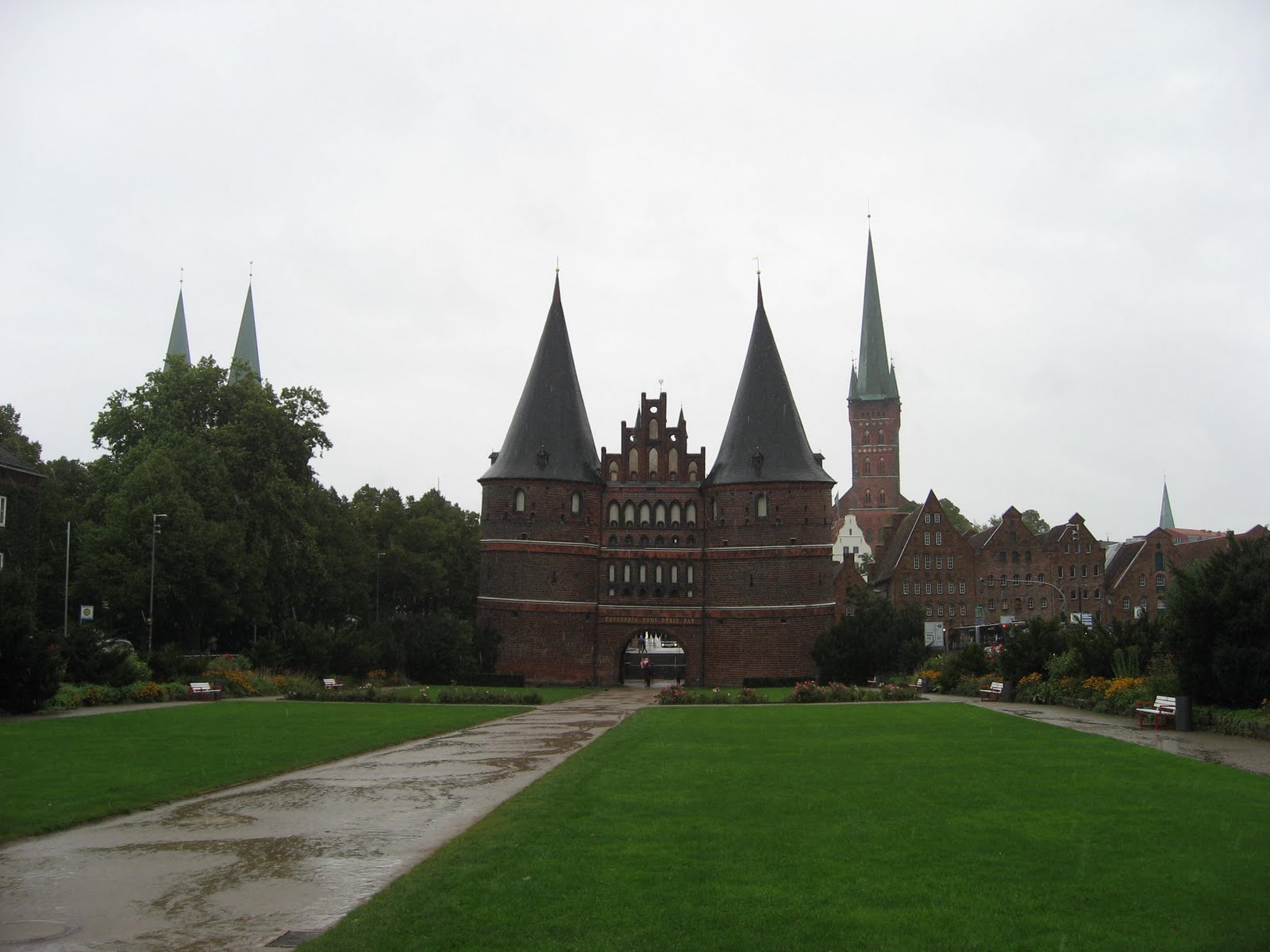
Lubeck was a member of the Hanseatic League, a medieval trading bloc.  Here stand the town gates.  Notice that the structure looks as though it is dragging towards the center.  That's because it is.  The gates are build on marshland, and the heavy center building is slowly dragging the towers toward it.


A quarter of Lübeck was destroyed by Allied bombing during World War II.  Remarkably, this Hansa-era building in the town square survived.

"Die Heimat Warten auf Sich" (The Homeland Waits for You).  This memorial inscribed on a wall in the town square commemorates German prisoners of war held by the Soviets.  Many German POWs died in Soviet captivity, and some were held well into the 1950s.  An adjacent memorial honors a number of local Protestant and Catholic clergymen who were beheaded by the Nazis for dissent.
The original bell in St. Mary's Cathedral fell and broke during a British air raid in 1942.


Although the weather is terrible, we walk around Lübeck for an hour and visit the homes of Willy Brandt and Thomas Mann.  The we board the bus and drive an hour West to Hamburg.  In Hamburg, it is still raining heavily.  Nonetheless, we take an hour-long walking tour:


Hamburg city center.


City hall

Fountain in the city hall courtyard


Looking across the Elbe

Tunnel under the Elbe
 We drop our stuff off at the Hotel Figaro (a sort of hotel-hostel hybrid) and go to dinner at Freischwimmer, a few blocks away.


This is what you get when you ask for a Coke in Germany.

Sign near the bathroom.  I have no idea what the hell this signifies.

Good stuff.
After dinner, we walk to a nearby bar for some drinks.  Two in our group challenge some Germans to a foozball match.  The Germans handily beat them.  Since it's a Thursday night, there isn't much going on, and we leave in search of a new bar.  On the way, we are joined by a middle-aged American laser engineer from San Francisco named Eric.  Eric is attending a conference in Hamburg and doesn't want to hang out with his fellow laser scientists.  We search far and wide, but Hamburg is dead, and seeing as we have to wake up at 7 the next morning, it's time to go home.  So we bid Hamburg's bar scene, and Eric the laser engineer, goodbye.


Sunday, September 11, 2011

Wednesday, September 7

This week, my European Memory & Identity class went on a field study to the Danish national gallery, and then on a study tour to the border regions of Denmark and Germany.

This first photo has nothing to do with what we learned.  It was my breakfast.  This is a Kanelbrød (cinnamon bread) that I bought from the Brønshøj Bakery the day before.  It costs about $4 and weighs about as much as a brick.  It is quite large and can be enjoyed over several days.  It has a chocolate and vanilla glaze and is filled with a heart-stopping apple-cinnamon custard that is truly delightful when the pastry is served warm.


 Here we see the exterior of the Statens Museum.  It is located in a part of Copenhagen reminiscent of the national mall and the Smithsonian museums: nearby are the botanical gardens and the geological museum.  The museum itself is surrounded by a beautiful garden crisscrossed by gravel walkways.  Denmark's national museums were originally born of private collections of miscellaneous items; only later were artifacts organized.  Our instructor says that only about a third of the museum's collection is on display at any given time.
Facade of the Statens Museum for Kunst
 
I walked through the botanical gardens while waiting for our class to arrive...

...and visited the nearby Rosenborg Castle (built 1606).  Note the moat and the sentry (and the renovation work).

19th-century Danish artists tended to exaggerate their homeland's landscape.  Denmark's coast is actually quite flat.

Artists also liked to embellish the weather, family relations, and the quality of life.  What a bunch of phonies.

Many young Danish artists found inspiration in southern Europe.  Here we see some bros from Bropenhagen broin' it up in Brome.  And it looks like some of them might be smoking bropium.

This one is called "Hendes Kaereste Overvejer at Spark min Røv" ("Her Boyfriend is Contemplating Kicking My Ass"). 

Sunday, September 4, 2011

Danish People

Danes.  What can I say about the people who I am surrounded by, and with whom I interact on a daily basis?

Europe's Canadians
Well, for starters, one Danish man has the strength of two Americans, and at least five Frenchmen.  A Danish person could beat the living daylights out of you.  But that would be uncharacteristically impolite.  

"I would prefer to discuss green energy."
 A Dane can put away a six pack, and then ride his bicycle safely home.  At night.  In the rain.

  
This is the finance minister.
Also, they all look like this:

The average Danish man and woman.
They have an excellent national health system, punctual public transportation, an eight-hour work day, six weeks of mandatory vacation time, and year-long maternity leave.

Godless commies.
Famous Danes include Hans Christian Andersen, Niels Bohr, Søren Kierkegaard, Tycho Brahe, and Prince Hamlet.  Denmark ranks as one of the happiest, most egalitarian, and least corrupt countries in the world.  National accomplishments include helping to found the European Union, saving 99% of Danish Jews during the Holocaust (making up for the pathetic two hours of military resistance it put up), and of course, defeating Grendel.

Did you know that there are 1.5 million Americans of Danish descent?  A diverse group, Danish Americans are represented by masters of drama...


...and kings of comedy.

That's Soren Bowie of Cracked, you heathens.
Yes, Danish-Americans scrape the skies of beauty...


...and plumb the depths of ugliness.

Kids, this is the bad man who took Napster away.

Overwhelmingly, Danes are extremely friendly and helpful, and nearly all of them speak impeccable English (which is more than can be said for many Americans).  What do Danes think of us Americans?  Here are some tidbits:

 Middle-aged Dane I met while pub-crawling:

"Where are you from?  Oh, God you're f***ing American!"
"There's no passion in your politics.  It's all about the money."

My Danish RA:
 
"Your country has a weight problem."

"We are a little taken aback by your liberal economy." (Americans take note: this is the correct use of the term "liberal")

"You're maybe a little too trigger-happy on the wars."

"Crime here is nothing compared to the states."

Danish woman:
"We hate American men."

Danish man:
"We love American girls."

Professor Christensen:
"How many people are there in Denmark?  What's that?  5 million?  That's 5.4 million to you people!"
 *Denmark is roughly the size of Maryland in terms of both geography and population, with Seattle's climate.

"And the industrial revolution began where?  Anyone?  Oh come on, are you people kidding me?"

So they're a wee bit critical of the good old USA.  But like all Europeans, they can't get enough of our soda, cigarettes, and candy bars.  Some of us may be Americans.  Some of us may be Danes.  And some of us are Iraqis, Croats, and Chinese.  But in the end, we all choose the smooth, robust taste of Coca-Cola.
 

Saturday, September 3, 2011

Bottle Collecting (and Dodging): Denmark for the Cheapskate

Decades of poor U.S. fiscal policy mean that, as an American student, I have to eat on a budget here.  $1 is equivalent to 5 Danish Kroner.  The Danish Kroner is pegged to the Euro, and 1 Euro is equivalent to $1.4.  So, things can get expensive, and one has to look for the right grocery store to get good deals. 


Some common grocery stores in Copenhagen are:
  • Fotik (expensive)
  • Irma (expensive, but good deals on wine)
  • Super Bruget (not too bad)
  • Netto (wonderfully cheap)
  • Night Netto (for all your Netto needs, 5-10 p.m.)
  • Ghetto Netto (the one in Nørrebro)
My $600 grocery stipend allows for a budget of $35/week.  Thanks to Netto, I am actually spending below that amount.

Approximate Netto prices, based on some items that I have purchased:

Food
Bread (cheap, 1 bag): 5 Kroner ($1)
Pasta (1 bag): 5 Kroner ($1)
Rice (1 bag): 10 Kroner ($2)
Eggs (carton of 6): 10 Kroner ($2)
Potatoes (1 bag): 5 Kroner ($1)
Carrots (1 bag): 5 Kroner ($1)
Asparagus (18 pieces): 12 Kroner ($2.40)
Apples (1 bag): 12 Kroner ($2.40)
Cheese (cheap, 1 pack): 5 Kroner ($1)
Pretzels (1 box): 5 Kroner ($1)
Chips (1 bag): 10 Kroner ($2)
Polish sausages (1 box): 10 Kroner ($2)
Salt (1 box): 2 Kroner ($0.40)
Olives (1 jar): 5 Kroner ($1)
Pickles (1 jar): 8 Kroner ($1.60)
Beans (1 can): 4 Kroner ($0.80)
Olive Oil (1 jar): 20 Kroner ($4)

Beverages
Orange Juice (1 carton): 12 Kroner ($2.4)
Instant Coffee (1 jar): 20 Kroner ($4)
Gin (70 cl): 100 Kroner ($20)
Wine (cheap, bottle or box): 20 Kroner ($4)
Beer (cheap, single): 5 Kroner ($1)
Beer (regular, single): 10 Kroner ($2)

Other
Soap, Shampoo, Detergent: 10 Kroner ($2)
Sponges (10-pack): 18 Kroner ($3.60)
Toilet paper: Foolishly stocked in abundance in the DIS bathrooms

There are two ways to save even more.  One is to look for deals in the Netto catalog, which I receive in the mail.  The other is to collect cans and bottles.  Denmark has a magnificent can and bottle return system, as explained in this video:


So last Sunday night, I decide to try my hand at bottle collecting.  And where would the biggest concentration of bottles be?  Downtown.  Specifically, the part with the bars.  More specifically, the part with all the bars for wasteful Americans who just leave their bottles on the sidewalk.

 The city was dead, and although Copenhagen is extremely safe, I took only my bus pass and keys with me, leaving my wallet, watch, and phone at home.  I spend an hour walking around the main streets and plazas near DIS, picking up plastic water bottles outside restaurants left by tourists, and empties sitting in doorways, left by drunks the night before.  Bottle collecting is a common enough activity that I don't gain any stares. 

After filling my big Ikea bottle bag, I start walking back to the bus stop.  The street is still very empty as I pass Fruh Plads, the large plaza near the University of Copenhagen.  An old man with a cane is walking by the university, and three drunk Danish kids are howling and smashing glass bottles on the ground. 

Passing the plaza, I can almost hear the bottle as it soars over my head.  But it is most definitely audible as it shatters against the brick building behind me, and I just escape the spray of glass.  For some reason, I just keep on walking.  The irony of the fact that it is a Sunday night in Copenhagen does not escape me.  That’s when I spot it.  Two 2-liters sitting on the curb on the other side of the street.  I peer over my shoulder.  The Danish kids have started down the street in the opposite direction.  Maybe it's because they've decide they've committed enough terrorism for one night.  Or it could just be that they've run out of bottles.  For several seconds, my mind engages in a furious debate.

"The coast is clear.  Those bottles are mine."
"What if those Danes come back?  They’re only a half a block away."
"Them?  They're drunk and their backs are turned.  I can outrun them, easy.  And that’s six Kroner.  SIX KRONER.”

Dare I?

That may as well be a bag of pretzels sitting on the curb.  Of course I dare.

Crossing undetected by all but the old man, totally undisturbed and still on his walk, I put the bottles in my bag.  That's when the Danes wheel around.

“Told you so, dumbass.” one part of my mind snaps to the other.
“Shut up.  What are they gonna do, come over and fight me?  Picking up bottles?  Yeah, right."  I look over again.  "Oh, wait -- yes, it indeed appears that's what that one fellow in the blue jacket intends to do.  Yes, there he goes, making that "You wanna go?" gesture that resembles a retarded pterodactyl flapping its wings.”

The blue jacket's friends are persuading him to turn around.  I am not inclined to wait around to see the result.  Still, they are very drunk, and since I at the moment I am smarter than the three of them put together, I merely turn the corner onto Skindergade.  To my delight, the Danes have decided it isn’t worth the hike.

On the bus back to Brønshøj, I tally my catch.  17 Kroner worth of bottles.  Was it worth an hour of walking and a run in with a few local ruffians? 

That’s eight and a half boxes of salt.  Damn right it was. 

Sunday, August 28, 2011

Getting Lost in Copenhagen

Copenhagen is said to be a fantastically easy city to navigate, but I have spent the last few days finding my way around by getting fantastically lost.

Getting Lost Alone
Monday night kicks off at the Compass Bar, a venue in Gammeltorv square with a courtyard and pass-out beds.  Compass is almost certainly geared exclusively toward Americans, and they're taking advantage of the influx of 1,000 of us with a no cover and free drink deal for DIS students.  By the time I arrive, Compass is mobbed, and it takes a good twenty minutes to actually reach the bar.  My free drink turns out to be the very last left in the entire bar.  The bartender rings a bell and shouts the bad news rather loudly.  The stereo plays the Star Spangled Banner as several hundred disgruntled and disheveled Americans spill out into the square.

It's one in the morning and I'm still jet-lagged, so I decide it's time to go home.  Despite having little idea of the outlay of the city, I manage to find my way back to Norreport station.  I soon realize I have no idea which bus to take home, as the one I am familiar with has stopped running.  While inspecting the bus bulletin, I bump into Xavier from the airport bus.

"Hey, what's up?"
"How's it going?"
"Do you by any chance know which of these buses goes to Brønshøj?" I ask.
"Nope." Xavier replies.  "Want to come back to Keops (kollegium) and figure out where to go?"
I speak the famous last words of the arrogant American in a foreign country: "No, I'll probably figure it out."

Attempting to read the Danish on the bulletin, I briefly consider giving up and taking a cab, but I'll be damned if I have to spend $60 on a cab ride.  The 81N looks like it might go in roughly the correct direction, so I hop on and hope for the best.

"Are you going to Brønshøj?" I ask the driver.  He gives me a puzzled look.  He is the first Dane I have met who does not speak any English.  "Brønshøj?" I ask again.  He sort of nods.

As the bus shoots north, I look out the windows for familiar landmarks.  It's awfully hard to tell in the dark, but I am reassured as we cross the water into the immigrant "ghetto" of Nørrebro.  There is an American college girl in the aisle next to me telling her North African seatmate about her recent arrest.

"Pardon me, are you going back to Brønshøj?" I ask.
"No, sorry.  You're a student?"
"DIS.  I live in Hoffmans Kollegium and I'm trying to get back to Brønshøj."
The girl looks at the African.  He shrugs.

As I peer out the window, I see the neon lights of Çamur's Kiosk, a convenience store I had been to the night before.  I get off the bus two stops down from Çamur's, but I want to confirm the direction I'm supposed to be walking in.  There's a bakery across the street, and two Middle Eastern men, one young and one old, are making pastries for the morning.

"Undskyld.  Taler du tysk, engelsk, eller spansk?"  I ask the elderly man.  He motions for the younger man to come over.  I ask the young man if he speaks German, English, or Spanish.
"English.  I am from Manchester."
Thank God.
The Middle Eastern Brit is very helpful; it turns out that Hoffmans is two blocks down the road.  I say thanks and walk in the direction he points.  I never thought I'd be so happy to see the tombstone dealer near our dorm as I walk home.

Getting Lost with a Group
The next day I look forward to more aimless traveling.  My navigation skills have not improved from the night before.  Trying to find the building where I am supposed to go, I walk through Gammeltorv.  I pass the Compass Bar, and I am amused to see a Carlsberg truck restocking the cellar.  I finally reach my building -- half an hour late.  It turns out that I'm not alone, however.  The instructor, a large, uninterested, balding Dane assigns my group -- several Americans and an Iraqi -- to go on a scavenger hunt around town.  Direction-finding does not go terribly well, but we do see these sights, among others:
Amalienborg Palace, home of the Danish Royal Family.
The dome of the Marble Church -- under repair, just like everything else in Copenhagen.

The waterfront.

Taking the Harbor Bus from the Playhouse to Christianborg.

There are some naval facilities located at the tip of the harbor.

The Parliament building.  Note the sandy terrain -- Copenhagen is an island, and we are essentially on a beach.

The view from the top floor of DIS.

Meeting back at the classroom after our 3-mile walk, we eat a traditional lunch of meat sandwiches and vegetables; the liver paste does not go quickly. I decide to spend the rest of the day pacing around the city, making a mental map.  I try to use word devices to memorize street names (this is difficult because there are no street signs -- street names are engraved on the sides of buildings at either end of the block); Købmagergade becomes cup-maker-gade because there's a coffee shop on it.  Strøget becomes stroll-get because it's a main walking artery.  By dusk, I have finally figured out the area around the classrooms, and the bus routes to and from Brønshøj during both day and night.

Not Getting Lost
Our Danish residence adviser, Mads, takes some of us on a walking tour of Copenhagen's bars and parks.  We go through the Latin Quarter, the Gardens, the waterfront area of Nyhavn, and Christiania.  Photos are prohibited in most of Christiania, but take my word for it -- there's nothing like it in the U.S.
Young musicians in Gammeltorv.

A rum snail -- the best pastry ever.

Picnickers in the Royal Gardens


A tour boat near Nyhavn.

The Playhouse


Town Hall

Christiania